
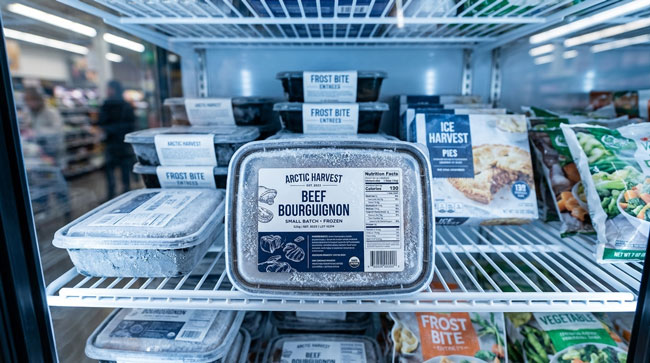
Freezer environments are brutal on labels. Between the extreme cold, condensation during temperature changes, and frost buildup, standard labels often curl, lift, or fall off entirely. If your product spends any time in a freezer — during storage, shipping, or at the point of sale — you need labels specifically engineered for those conditions.
Why Standard Labels Fail in Freezers
Standard permanent adhesives are designed for room-temperature application and storage. At freezing temperatures, many adhesives become brittle and lose their tack. The adhesive literally can’t grip the container surface. Paper facestocks absorb moisture from condensation and frost, causing wrinkling and delamination. And the constant freeze-thaw cycle — every time the freezer door opens — stresses the bond repeatedly.
What Makes a Freezer Label Different
Freezer-grade adhesive: The most important factor. Freezer adhesives are formulated to remain flexible and tacky at temperatures well below zero. They maintain their bond through freeze-thaw cycling and resist moisture from condensation.
Film facestock: BOPP or other synthetic films resist moisture absorption and maintain dimensional stability in cold environments. Paper can work with a laminate finish, but film is the safer choice.
Apply at room temperature: Even freezer-rated adhesives perform best when the label is applied to a dry container at room temperature. Applying labels to already-frozen or frosty surfaces dramatically reduces adhesion. Let the adhesive bond before the product enters the freezer.
Products That Need Freezer Labels
Frozen meals, ice cream, frozen meats and seafood, frozen fruits and vegetables, ice packs, frozen pet food, and any product that will be stored or displayed in a freezer case.
Check out our freezer labels and make sure your product stays labeled from the production line to the consumer’s freezer.
