
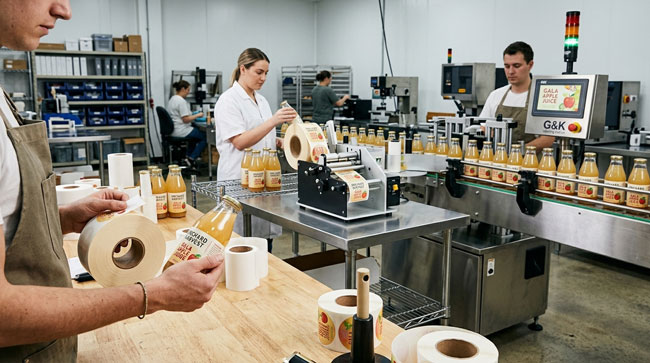
How you plan to apply your labels to your containers affects several ordering specifications — including roll direction, core size, and maximum roll diameter. Understanding the three main application methods helps you make the right choices when building your label order.
Hand Application
The simplest method: peel labels from the roll by hand and press them onto the container. This works well for very small runs (under a few hundred units per session) and for products with irregular or unusual container shapes that don’t fit in a machine. Hand application is slow but requires no equipment investment. When ordering for hand application, roll direction is less critical — any unwind direction works.
Semi-Automatic Application
Semi-automatic applicators dispense one label at a time, which you then position on the container by hand or with a simple fixture. These tabletop machines speed up the process significantly — typically 10-20 labels per minute — while keeping equipment costs relatively low (a few hundred to a few thousand dollars). When ordering for a semi-automatic applicator, you’ll need to specify the correct unwind direction for your machine.
Fully Automatic Application
Automatic labeling machines integrate with your production line, applying labels to containers as they move past on a conveyor. Speeds range from 50 to several hundred labels per minute. These systems require specific roll specifications — unwind direction, core size (typically 3″), maximum roll outside diameter, and consistent label spacing are all critical. When ordering for automatic application, confirm your machine’s requirements with the manufacturer and communicate them to your label printer.
Why It Matters When Ordering
If you tell your label printer you’re using an automatic applicator, they’ll set up your rolls to match your machine’s specs. If you don’t mention it and receive rolls wound in the wrong direction, you’ll have labels that don’t feed correctly — a frustrating and preventable problem.
When building your label at LabelSwift, you’ll specify your application method and unwind direction so your rolls arrive ready to use.
