
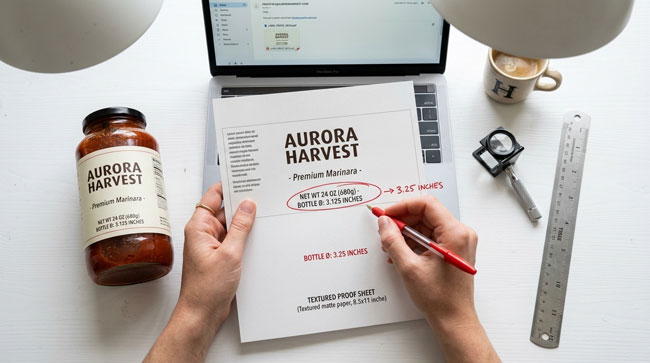
The proof is your last chance to catch errors before your labels go to press. Once you approve, that approval authorizes production — and reprints due to issues that were visible on the proof are typically at your expense. Taking 15 minutes to carefully review your proof can save you hundreds of dollars and days of delay.
What to Check
Spelling and grammar: Read every word. Read them again. Have someone else read them too. Typos are the most common and most preventable error in label printing. Pay special attention to product names, ingredients, contact information, and URLs.
Regulatory information: Verify that all legally required elements are present and correctly formatted — nutrition panels, allergen declarations, net weight, manufacturer information, and any required warnings or disclaimers.
Barcode and QR codes: Confirm your UPC or QR code is present, correctly positioned, and legible. If possible, scan it to verify it resolves to the correct product or URL.
Colors: While digital proofs are approximate (colors on screen are never an exact match to print), check that nothing looks obviously wrong — a blue that should be navy appearing as sky blue, or a brown that looks orange.
Die line and dimensions: Verify the label dimensions match your container. Check that no critical content is too close to the cut edge.
Version control: Make sure this is the correct, most current version of your design. Multiple revision rounds can create confusion about which version was final.
When to Request Changes
If anything needs to change, respond to your proof with specific, detailed corrections. Avoid vague requests like “make it better” — point to exact issues with exact fixes. Each revision cycle adds time, so aim to consolidate all changes into a single round of feedback.
Questions about the proofing process? Visit our proofing and review guide.
